

This year marks five years of Appalachia Book Company. Five years of reading submissions, publishing chapbooks, and asking ourselves the same question over and over: what makes writing Appalachian?
ABC publishes writers with a connection to central Appalachia—and that connection can look a lot of different ways. Maybe you grew up here. Maybe you moved here, spent time here, or chose to set a story in our region. We want to be inclusive.
But I’ve also learned something in those five years of reading: when the connection is there, you feel it. It shows up in the details. The dialect—not just the vocabulary, but the music of it. The landscape—not just described, but felt. The history—not just referenced, but understood as something that shapes people, that lives in them.
Details like that can’t be faked. They come from paying attention. From listening. From time spent in a place, or with its people, or in the pages of those who came before.
That’s what I look for when I read. Not a setting or a stereotype, but a sense that the writer knows something true about this place—and has found a way to put it on the page.
After five years, I have my own answers. But I’m curious about yours.
A reader survey can be found at the bottom of this newsletter—we’d love to know what you think makes writing Appalachian, and what you want to see from us next.
Appreciate you.
—Natalie
Catching Up
We’ve been quiet the past few months, and a lot of you are new to our project. Here’s a look at what we’ve got going on.
Appalachia, there is a future, and we’re gonna show you how writers see it.
When we started putting together These Dreaming Hills—our anthology of Appalachian speculative fiction—we wanted stories that asked: What if? What comes next? What’s been here all along that we haven’t seen?
We’re thrilled to announce that Noah Ashley Blooms is taking over as editor. If you’ve read Every Bone a Prayer, you know Blooms understands how to write Appalachia with both grit and tenderness. We’re in good hands.
Writers who submitted work for consideration will hear from the editorial team by the end of this month.
‘The Storied Song’ is coming this March!
On a September evening last fall, a small crowd gathered at the Appalachian Center for the Arts. The lights dimmed. A narrator’s voice filled the room, and for the next few hours, old ballads—the kind passed down through generations, sung on porches and at kitchen tables—came back to life in a new form.
That was the live recording of The Storied Song, our podcast series that transforms traditional Appalachian ballads into radio plays. Playwrights Jess Wells, Anne Gillespie, Diana Jean Skeen, and Ida Esmaeili each took a different ballad and cracked it open, finding the story inside the song. William Ritter narrated. Michael McNulty directed. Rosa Bott designed the sound. Samuel O’Sullivan engineered it all.
We’re in post-production now, and we can’t wait to share it with in March. More soon.
New Made In Appalachia prose chapbook available now!
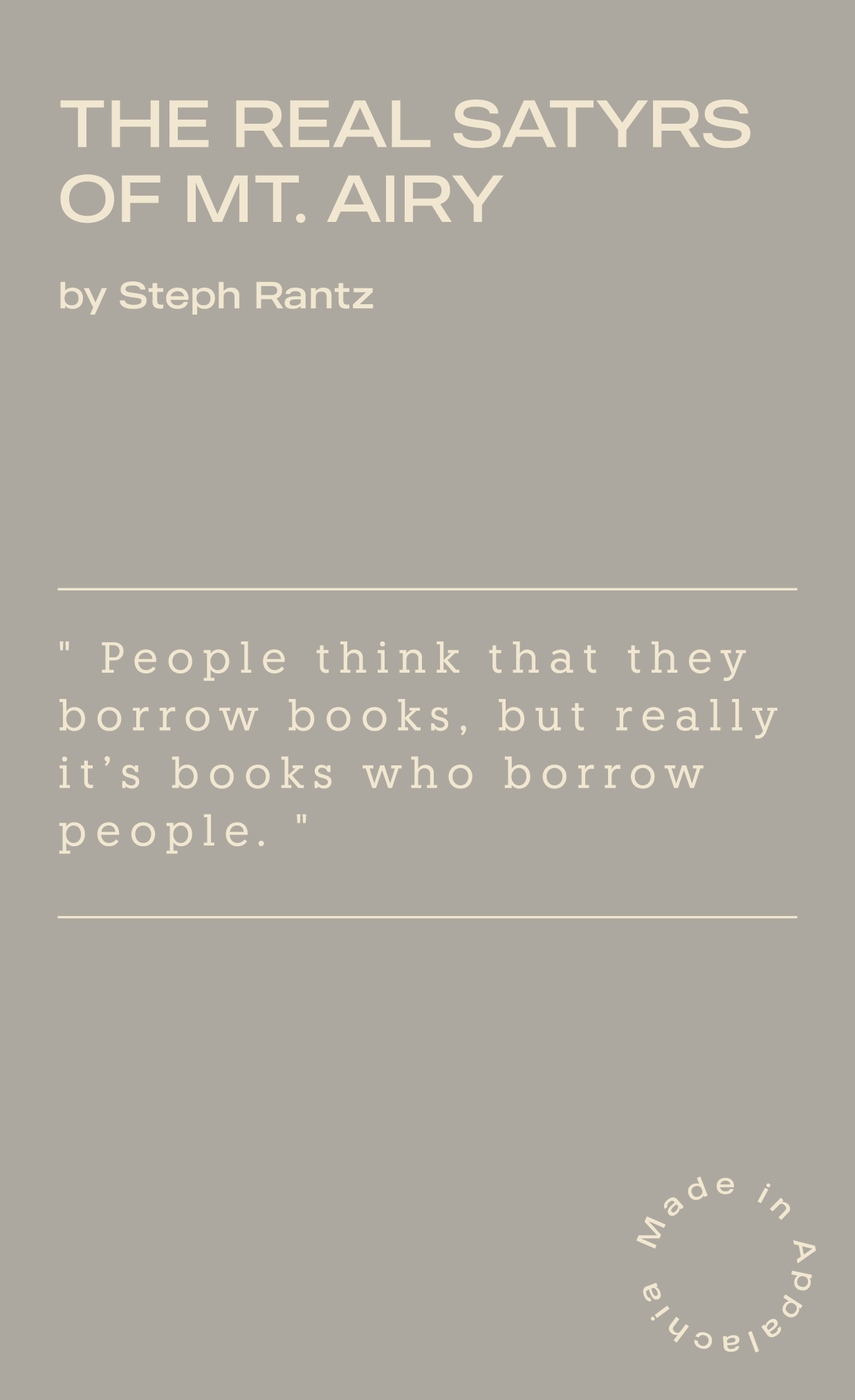
A Librarian Walks Into a Story
For thirty years, author Steph Rantz carried a story around with him. He’d started writing it, set it aside, picked it up again. And again. Then came quarantine, and a short story class, and Jorge Luis Borges.
“I put all my love for libraries and books into the story,” Steph says.
The result is The Real Satyrs of Mt. Airy, the newest chapbook in our Made In Appalachia series. It follows Talmadge Strong, a librarian at the Mount Airy Library, as a mysterious fever blurs the line between the stacks and ancient myth. Reality slips. Legend seeps in.
Steph has worked in a historical library for 25 years. Questions about nearby Mount Airy—and its fictional twin, Mayberry—were part of the job. “Surry County lore and history,” he says, “have just been built into my DNA.”
He’s also just been named a finalist for the 2026 Saints and Sinners Short Story prize. Congratulations, Steph.
Read The Real Satyrs of Mt. Airy →

Writers: Made In Appalachia is open for fiction and nonfiction submissions.
You have until March 1 to get your stories in. Submit via Submittable.
Get a Free Chapbook!
We’ve been asking ourselves what makes writing Appalachian for five years. Now we want to ask you. What draws you to these stories? What are we missing? What would make this newsletter something you look forward to?
Take our short survey, and we’ll send you a free chapbook from our catalog as a thank you.
Writing is Appalachian when it comes from the mountains with honesty about the land and the people who live on it. It carries the rhythms of local speech, a long memory of labor and loss, and a stubborn sense of place. It is also a lived experience that cannot be faked. The setting matters, the history matters, and the community matters. Without that grounding, it is just a story set in Appalachia, not writing shaped by it.
I’ve asked this to myself recently over and over. I’m working on finding my voice currently. Thankful I found this Substack. I’ll have a submission for your review very soon